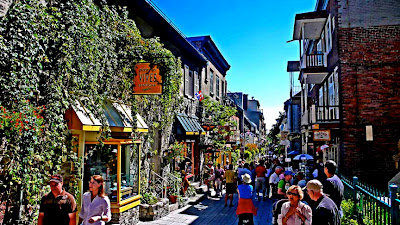
Friday, August 24, we woke to heavy rain in our camp outside of Ville de Québec. Dallying for a few hours, hoping the weather would clear, Bill finally moved us over to the dump station for that necessary weekly chore, then set out at 11:30 a.m., for the first time on the trip in a westerly direction, toward Montréal. After driving in a gusting rain for an hour, it finally did clear so most of the 160 miles on autoroute 40 along the St. Lawrence River was smooth sailing. Approaching the bridge over the St. Lawrence River to the Island of Montréal, traffic tightened up. Slowly crossing town on the elevated road, Millie (our GPS Navigator) guided us to our next “camp,” the Missionaries of Africa (White Fathers) Provincial house at 4:30 p.m. An old friend, Fr. Pierre LeClerc, who was on the plane with us when we all arrived in Malawi for the first time in 1959, greeted us and arranged food for all of us. After dinner we had a good time remembering our early days in Malawi (called Nyasaland, at that time).
Which reminds me of a story: as Fr. LeClerc, Jean, and I disembarked from the plane at Nyasaland’s only airport with a paved runway in August of 1959, Jean and I were greeted out on the “tarmac” by the Bishop and an American priest from our Diocese up in Northern Malawi, while poor Father LeClerc ended up staying his first night at the local flea trap hotel waiting for the people from his Diocese to come for him. Jean and I were whisked away to stay in a comfortable guest room at a local Catholic high school. But we did have a learning experience about African termites that first night: the room was very clean with painted walls and polished cement floor, but the brothers had not thought about a clothes closet, so we casually tossed our 24-hour-on-the-plane clothes onto the shiny smooth floor. Well, some of Jean’s under clothes were made of rayon, which is a form of cellulose as found in wood—wood eating termites somehow got through a crack in the floor and ate large holes in her underwear! Then there was the time I came out of the door to find a cobra raised up, striking, and spitting at our big black mama cat…
Words are insufficient to relate the warm welcome we received from the religious we had worked among in Malawi. During our 4 day visit, we met 3 priests and at least 15 sisters we had not seen for 30 years. It was old home week! Hugs and kisses (on both cheeks!). Stories related about remembered events and people! Photos brought out to refresh memories and to bring us up to date!
We had not remembered that Montréal and Laval were side-by-side islands in the St. Lawrence River. From the roof top of the M.I.C. (Missionary Sisters of the Immaculate Conception) Sisters house of retirement in Laval, we had an excellent view of the St. Lawrence River and a bridge from Laval to Montréal.
Our hosts gave us complete tours of their communities and stuffed us with all kinds of good things, as Sisters are wont to do. Then over a two-day period from 9 in the morning ‘til 8 at night, we toured the the city of Montréal and its port and visited the three major churches we were hoping to see.
The base of the Cathedral of Mary, Queen of the World, erected in 1870 - 1894, contrasts with a modern skyscraper in blue glass. The Archbishop’s Cathedral is immense, although it is an exact one-third scale replica of St. Peter’s in Rome.
Downtown Montréal features many skyscrapers linked underground by a maze of walkways stretching some 18 miles and embracing 1,600 shops, a department store, 200 restaurants and 30 theaters. Subterranean promenades and the Métro connect the clusters of buildings of underground Montréal.
Montréal’s position between the Atlantic Ocean and the Great Lakes serving large areas of Canada make its port a very busy one. There are also many pleasure craft along the waterway.
We particularly wished to visit St. Josephs Oratory, a massive concrete basilica which began as a simple wooden chapel on the steep hillside of Mont-Royal. Br. André Bessette, a Holy Cross Brother served as gate keeper there until his death in 1937. Br. André cured thousands of pilgrims for which he credited St. Joseph. Abandoned canes and crutches decorate enormous entrance panels.
N.B. We have been involved for the past 6 years in writing the history our parish church, St. Joseph of Mountain View. Part of our Parish’s history involves the Holy Cross Brothers who established and operate St. Francis High School in our Parish.
The Basilica of Notre-Dame de Montréal was started in 1830 to replace the original parish church of 1672 in what is now the historic district near the waterfront. On completion 50 years later, it was the largest church in North America. The rather unpretentious exterior betrays the magnificence of the interior.
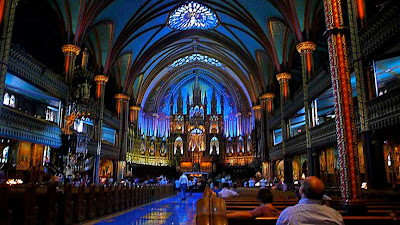
The lighting plan of the hugh church is masterfully executed. I tried to capture it in these two dimensional images, but they only suggest what it is really like. You have to be there to feel the vast nave receding into the darkness beyond, surrounding you with the coolness of outer space, the vault of the ceiling in deep blue with golden stars, and the crimson pillars outlined in gold caught by your peripheral vision.
As you approach the sanctuary you are overwhelmed by the blazing golds of the crucifix, bright shining blues in the background, warm reds and oranges delineated by rich purples, and fresh green emphasizing the spires over the crucifix. Interestingly, the stained glass windows depict the religious history of Montréal rather than the usual biblical scenes.
Having fulfilled all our hopes for renewing our acquaintance with the M.I.C. Sisters and the White Fathers and of visiting three of the major churches of Montréal, we left Québec Province and headed southwest—in the direction of home.
Thursday, September 20, 2007
Thursday, September 13, 2007
116.8/22 Ville de Québec—Parlez-vous Français?
Ville de Québec
Saint Lawrence River taken from
De l’Observatire de la Capitale viewing tower
725 feet above sea level.
Our campground, Camping Juneau on Lake Augustine, was conveniently located just off of autoroute 40. Our camp hostess instructed us, “Don’t turn off anywhere, just go straight forward into ville de Québec." (only 18 km, about 12 miles, along freeway 40, straight ahead on 440, then Boulevard Charest Est, then St. Paul which curves around the base of Old Québec to the Old Port and commercial parking area on the shore of the St. Lawrence River.)
We did take her advice to return to camp at the end of the day, but made use of our GPS, Nellie, to first take us up on the bluff to the Vue sur Québec, from the Observatory of the Capital of Québec Province. Finding road construction blocking several streets and full parking lots, we drove into Des Plaines d’Abraham a large civic park, resembling Golden Gate Park in San Francisco where we found free curb-side parking several blocks away. We cut across a grassy slope, Bill going to the left to the Viewing Tower and Jean to the right to the Tourist Information Center.
After enjoying our lunch in the park, Bill slowly went with the traffic through the narrow streets of Old Town, down the steep Cote de la Montagne to the Old Port below. One thing that we learned quickly: Jean’s knowledge of French was going to be needed. The Québequois, at least the government, is as paranoid about the French language as the country of France is. One striking example: all over the rest of Canada and in most of the northern states every sign and all product labels are written in English AND French, but not in Québec—here only French is found, no English.
At Place Royal, the first French settlement in North America, founded by Samuel de Champlain in 1608, we visited the little stone church, Notre-Dame des-Victoires, “Our Lady of Victories,” built in 1688 on the foundation of Samuel de Champlain’s trading post. The famous Chateau Frontenac towers overhead. We sauntered along cobblestone streets among the tourists; Jean bought postcards and Bill indulged in an ice cream cone ($3.50). Nearby is the base of the funicular that you can take to the upper town rather than climb the steep stairway.
Taking the straight road home around 4 p.m. seemed interminably slow through the narrow streets of the town with bumper to bumper one-lane traffic, very rough pavement and many signals, until it became a freeway for the last few miles to our campground.
Ste. Anne de Beaupré
The next day we headed northeast, about 20 miles beyond the town of Québec to the shrine of Ste. Anne de Beaupré, using the slightly longer freeway 40 detour around the town of Québec and arriving just in time for the 11:30 a.m. pilgrim’s Mass. The beautiful basilica is a peaceful, quiet place out in the country. During the 350 years of it’s existence, many healings have taken place here, credited to Saint Anne, the mother of the Virgin Mary. In 1876, at the opening of the first basilica, Saint Anne was proclaimed patroness of the Province of Québec.
This panel depicts
The Annunciation to the Blessed Virgin Mary.
by a special service for pilgrims.
Strolling about the grounds after Mass, we noticed a small building with the title, "Counseling and Blessings." Curious, we went in and met a very black, young priest from Burkina Fasso, Africa. We shared mission-talk briefly, until another pilgrim arrived. We left feeling very much at peace after receiving his priestly blessing.
111.8/17 Acadia National Park, Maine
In 1604, Samuel de Champlain sighted Mount Desert (day SAIR) Island, and named it, “L’Isle des Monts Deserts,” which means island of the bare mountains.
Finally, we had reached colder climes! It took a long time to get there; the cool made us into “happy campers.” Highway 95 north to Bangor was a dream, well paved, multi-laned and scenic, with wide grassy edges and median in deciduous woodland. The next 66 miles SW to camp on Mt. Desert Island was another story: narrow, rough road, mostly 2 lane and bumper to bumper traffic to get to the Visitors Center near the town of Bar Harbor.
Of all things, the center had 37, or was it 57 steps, up to the building. It was a Friday afternoon and we were afraid we would not find a place in a campground. Bill had phoned several days earlier and been told he could only reserve for the next week, but just go ahead and register on arrival. We were now informed than Blackwoods Camp was full, but that Seawall C.G., 18 miles away and the only other campground in the Park, still had a few open sites. If only we had known, we should have aimed directly for Seawall Camp Ground and avoided about 10 miles of congestion. We dashed down the stairs and hurried on. Fortunately we now had a park map, and with Nellie, navigated several road junctions that were not very well marked.
What a beautiful place! We were in a spruce forest that looked, smelled, and felt like Yosemite Valley campgrounds. Selecting our site, we promptly signed up for a 4-day stay. What a bargain! With Golden Age Passport, only $5.00 a night. The next two days were rainy, so we stayed quietly at home, enjoying the cool ambience, with Jean getting acquainted with the campground flora and walking 15 minutes to the shore at Seawall.
The beautiful Swamp Rose, Rosa virginiana, with 2 to 3 inch diameter shocking pink flowers and large scarlet hips, grew in 5 to 8 foot masses wherever there was water.
Bill enjoyed few wild raspberries on his breakfast cereal; Rubus idaeus was found in wet ditches around the camp.
There are carriage roads all over the Island, wide gravel tracks closed to vehicle traffic, except bicycles. You can bike, hike, or stroll for miles.
Yellow Birch, Betula alleghaniensis brightened our campground and meadow clearings. The papery bark has a golden tan cast, not as white as the paper birch, or quaking aspen which are also present in Acadia.
The roadsides and mossy forest floor everywhere were dotted with berries of the scarlet Bunchberry, Cornus canadensis, a miniature dogwood found across the north of the United States and throughout Canada.
The third day Bill drove the RV a total of 72 miles to explore the Island. We first went up Cadillac Mountain, 1,530 feet elevation and the highest mountain on the East Coast north of Brazil.
You are presented with a panorama of the deep blue sea, the surrounding islands, lakes, and forests, and to the west even higher mountains. This summit is the first place the the sun touches the United States every morning.
Returning to the start of the one-way Park Loop Road, we stopped at the native plant garden, Sieur de Monts Spring, then leisurely drove along the scenic rocky Atlantic coast around the island. The Park occupies about 40% of the Island.
Sieur de Monts plantings were arranged in habitat areas, with nearly every type of plant, tree and fern labeled. In early summer mode, the garden was all in shades of green. Blueberries and Cranberries were forming; fall colors of aster and goldenrod just beginning. One bright spot was the Cardinal Flower, Lobelia cardinalis growing beside the little stream.
Another great feature about Acadia N.P. is the Island Explorer shuttle buses, partly supported by L.L. Bean Sporting Goods Co. and partly by the National Park Service. Free rides! On the hour! Hub at Bar Harbor Village Green. Reaching all the little towns, harbors, trail heads and many of the scenic points!
On our last day, Sunday, we hopped on the shuttle at the campground entrance and went into Bar Harbor for church, to view the harbor, and to mingle with the tourists. We were reminded that 40 years ago, while we were teaching in Africa, we traveled by bus around the U.S. and visited Acadia National park. The Pastor of the Catholic Church in Bar Harbor loaned us his car to drive around the island, and then that evening drove us the 66 miles to Bangor to catch the Greyhound bus going to Quebec
Bar Harbor had long been a watering place for the wealthy, some of whom had the foresight to form a group of Trustees to help preserve some of the beautiful spots on the Island. They acquired about 5,000 acres which they presented to the Federal Government. President Woodrow Wilson signed Sieur de Monts National Monument into existence in 1916. After more land donations, in 1919 an act of Congress redesignated it as Acadia National Park, the first national park to be established east of the Mississippi River.
Finally, we had reached colder climes! It took a long time to get there; the cool made us into “happy campers.” Highway 95 north to Bangor was a dream, well paved, multi-laned and scenic, with wide grassy edges and median in deciduous woodland. The next 66 miles SW to camp on Mt. Desert Island was another story: narrow, rough road, mostly 2 lane and bumper to bumper traffic to get to the Visitors Center near the town of Bar Harbor.
Of all things, the center had 37, or was it 57 steps, up to the building. It was a Friday afternoon and we were afraid we would not find a place in a campground. Bill had phoned several days earlier and been told he could only reserve for the next week, but just go ahead and register on arrival. We were now informed than Blackwoods Camp was full, but that Seawall C.G., 18 miles away and the only other campground in the Park, still had a few open sites. If only we had known, we should have aimed directly for Seawall Camp Ground and avoided about 10 miles of congestion. We dashed down the stairs and hurried on. Fortunately we now had a park map, and with Nellie, navigated several road junctions that were not very well marked.
What a beautiful place! We were in a spruce forest that looked, smelled, and felt like Yosemite Valley campgrounds. Selecting our site, we promptly signed up for a 4-day stay. What a bargain! With Golden Age Passport, only $5.00 a night. The next two days were rainy, so we stayed quietly at home, enjoying the cool ambience, with Jean getting acquainted with the campground flora and walking 15 minutes to the shore at Seawall.
The beautiful Swamp Rose, Rosa virginiana, with 2 to 3 inch diameter shocking pink flowers and large scarlet hips, grew in 5 to 8 foot masses wherever there was water.
Bill enjoyed few wild raspberries on his breakfast cereal; Rubus idaeus was found in wet ditches around the camp.
There are carriage roads all over the Island, wide gravel tracks closed to vehicle traffic, except bicycles. You can bike, hike, or stroll for miles.
Yellow Birch, Betula alleghaniensis brightened our campground and meadow clearings. The papery bark has a golden tan cast, not as white as the paper birch, or quaking aspen which are also present in Acadia.
The roadsides and mossy forest floor everywhere were dotted with berries of the scarlet Bunchberry, Cornus canadensis, a miniature dogwood found across the north of the United States and throughout Canada.
The third day Bill drove the RV a total of 72 miles to explore the Island. We first went up Cadillac Mountain, 1,530 feet elevation and the highest mountain on the East Coast north of Brazil.
You are presented with a panorama of the deep blue sea, the surrounding islands, lakes, and forests, and to the west even higher mountains. This summit is the first place the the sun touches the United States every morning.
Returning to the start of the one-way Park Loop Road, we stopped at the native plant garden, Sieur de Monts Spring, then leisurely drove along the scenic rocky Atlantic coast around the island. The Park occupies about 40% of the Island.
Sieur de Monts plantings were arranged in habitat areas, with nearly every type of plant, tree and fern labeled. In early summer mode, the garden was all in shades of green. Blueberries and Cranberries were forming; fall colors of aster and goldenrod just beginning. One bright spot was the Cardinal Flower, Lobelia cardinalis growing beside the little stream.
Another great feature about Acadia N.P. is the Island Explorer shuttle buses, partly supported by L.L. Bean Sporting Goods Co. and partly by the National Park Service. Free rides! On the hour! Hub at Bar Harbor Village Green. Reaching all the little towns, harbors, trail heads and many of the scenic points!
On our last day, Sunday, we hopped on the shuttle at the campground entrance and went into Bar Harbor for church, to view the harbor, and to mingle with the tourists. We were reminded that 40 years ago, while we were teaching in Africa, we traveled by bus around the U.S. and visited Acadia National park. The Pastor of the Catholic Church in Bar Harbor loaned us his car to drive around the island, and then that evening drove us the 66 miles to Bangor to catch the Greyhound bus going to Quebec
Bar Harbor had long been a watering place for the wealthy, some of whom had the foresight to form a group of Trustees to help preserve some of the beautiful spots on the Island. They acquired about 5,000 acres which they presented to the Federal Government. President Woodrow Wilson signed Sieur de Monts National Monument into existence in 1916. After more land donations, in 1919 an act of Congress redesignated it as Acadia National Park, the first national park to be established east of the Mississippi River.
Saturday, September 8, 2007
105.8/11 Longwood Gardens in Pennsylvania
Our hosts, Jim and Dora Gleeson in Wilmington, Delaware, friends from 1954 when we were together in the Army at Dugway, Utah, offered to take us to Longwood Gardens. It was a lovely drive on a small country road along Brandywine Creek.
Jim guided us along the well shaded paths. The view from the conservatory wall above the main fountain garden shows some of the 380 fountains in a quiescent mode. More elaborate light displays are programmed for evening or special event shows.
Bill is in the center of the Flower Garden Walk where two long brick walks extend from his left and right. Each is flanked by a 3 or 4 tiered display in color coordinated groups, such as the Scarlet Crested Cockscomb in the foreground of the reds, or the Zinnia in the yellow section. Dwarf pink Dahlias fill the foreground, while a mass of Pentas lanceolata attracts swallowtail butterflies in the middle tier of the pinks. There are also sections in white, blue, orange, and purple; all in compact, perfectly maintained plantings.
In 1906 Pierre Du Pont, bought the property from the Peirce family who had already established a forest and made the public welcome. Mr. Du Pont, chairman of the DuPont and General Motors Companies made his home there and continued development of the property and expanded the gardens. Today, more than 300 employees and students along with 500 volunteers keep Longwood’s 1050 acres beautiful and open to the public all year. Bill’s niece Elizabeth Pawek, now Mrs. Brian Shaw, mother of two, served a prestigious summer scholarship there 21 years ago in 1986 when enrolled at Cal Poly University in Ornamental Horticulture.
The pool at the entrance of the East Conservatory gives you an idea of the variety in the interior gardens.
and the thinner
Royal Water-platter, Victoria amazonica
Although we visited and photographed many other beautiful and interesting specialty rooms, such as orchids and euphorbias, we were entranced by the Outdoor Waterlily Display. The giant rimmed leaves of the Santa Cruz Water-platter, Victoria cruziana and the thinner Royal Water-platter, Victoria amazonica are flanked by many species of Nymphaea, both day and night blooming.
The tall, sacred lotus, Nelumbo nucifera from Asia has edible flowers, seeds, young leaves and roots. The dried seed pods are used in flower arrangements. Sacred lotus is the oldest seed ever germinated: 1,300 years old from a dry lake bed in northeastern China.
We had a taste of the evening fountain programs by attending the noon show in the amphitheater where fountains spouted synchronized with marching tunes.
Subscribe to:
Posts (Atom)