Saturday, March 22, 2008

151.9/26 The Road to the Top of the World

The Trail Ridge Road (US 34) traverses 42 panoramic miles over the North American continent’s backbone from Estes Park on the east through Iceberg Pass over 12,000 feet elevation down to Grand Lake at the foot of the Never Summer Mountains on the west. It is an easy way to see the vistas of the “back country” from your car. Rocky Mountain National Park was created in 1915 (a year before the National Park Service was formed) and Estes Park has been a favorite destination for Easterners and Midwesterners for over a hundred years (See appendix.).

Trail Ridge Road


Longs Peak & the Continental Divide


Longs Peak, 14,259 ft.

Longs Peak is the highest of the 72 named peaks that are above 12,000 feet elevation in the National Park.

From Rainbow Curve overlook:
Horseshoe Park toward Estes Park


One of the grandest views on the Trail Ridge Road is from Rainbow Curve looking over the road of “many curves,” the Beaver Ponds, Sheep Lake, and the Fall River in West Horseshoe Park.


Mr. Marmot surveys his kingdom

The Yellow-bellied Marmot enjoys basking in the sun on rocky outcroppings.


On top of the world at 11,875 ft,
eleven satellites are visible to Millie
at the Tundra Trailhead


Millie is our GPS navigator; besides finding addresses in city jungles, she tells us the elevations in the mountain wilds. Usually, she “sees” only 6 or 7 satellites.


Jean explores the Tundra Communities

At this late date, October 23, most of the plants have succumbed to the freezing winds and rain. But as usual, Jean did not come back empty-handed.


“Belly flowers,” Arctic Sandwort, Arenaria obtusiloba


Alpine avens, Acomastylis rossii


From 12,183 ft at the highest point
on the highest major road in the U.S.
near Iceberg Pass


Comfort stations at 11,800 ft.


Dandelion, Taraxacum officinale
at the Visitor Center


Dandelions are found from below sea level to above tree-line (Alpine).


Grass in the snow

At this elevation snow is present for most of the year.


View West from Visitor Center
toward the Never Summer Mountains


Penny-cress, Thalaspi arvensis

Appendix

This is an edited excerpt from my mother’s biography of her father, Henry Field of Shenandoah, Iowa, about two trips he took from Iowa to Estes Park in 1911 and 1912 on the old transcontinental Lincoln Highway (approx. US 40, today).

“The trip home was without incident until we were near Holbrook, Nebraska. We came upon a bad mud hole where a heavy rain had washed across the road leaving it a muddy lake. Henry raced the engine of our EMF Touring Car, trying to make a fast run through the spot. The car plunged in and began to sink in the soft, soupy mire, rocking from side to side, straining for traction. Suddenly the car tipped toward the right and came to a stop. When Henry stepped gingerly out into the knee-deep mud, he found the right rear wheel lying flat on the ground, broken off at the axle.


“Everyone piled out onto the high and dry roadside bank and set up camp in a conveniently near tree-shaded farmyard. Henry got a ride to town, telegraphed Omaha for parts and arranged for a man to pull him out of the mud hole. Within two days the new axle was shipped from Omaha and installed by the local mechanic. The axle cost $6.00 and the mechanic charged $6.00 more. There had been only two days delay and Henry proceeded homeward without further trouble. The trip took us seventeen days in all.

“The next year, he bought a new 1912 Everett car—quite similar to the EMF, but larger. When he first got the Everett he put it up to fifty miles an hour, but half a mile of that was enough. Fifteen or twenty miles an hour and one hundred miles a day were enough for anyone, he decided. He took all six of us children for the trip to Colorado this time. We camped longer at Estes Park and took a different route home.”


What’s coming up? I am so glad you asked:
1. 153.09/27 Some of the trails and lakes of Rocky Mountain National Park
2. 161.10/06 Struggling through the snow to get home (with complete stats of the trip)
3. 3.02/19 /08 Fancy flowers of Death Valley National Park
4. 5.02/21/08 The poster peaks of Death Valley

Bill & Jean.

Thursday, January 17, 2008

150.9/25/07 Rocky Mountain National Park-Estes Park

Perhaps you thought we never went home or we got lost and are wandering around looking for “the way to San Jose.” The real situation is that we did make it home overcoming great challenges (chillingly related in an up-coming blog) only to find life at home is a lot more complicated than life as gypsies on the road. I have thought about it a lot since we have been back—I have decided that “full-timers” (the ones who live in their RV all year and follow the seasons) are on to something. No, we’re not planning to abandon our home nest—but it does makes you think.

There are a least four to five more blogs in the works—the last will be an epilog summing up our statistics, experiences, and feelings about our five and a half month celebration of our 80th birthdays. (We have another milestone in our young lives coming up this year: the celebration of our 60th wedding anniversary over the weekend of September 5th – 7th) [Yes, it’s true, Jean was not “of age” when we were married, but that’s another story—a very interesting story, but one for another time.]

But I digress. If you remember the last location was Scotts Bluff, blog #145.9/20 “A Lighthouse on the Oregon Trail.” There, we weighed the alternatives of a side trip down to Colorado’s Rocky Mountain National Park at Estes Park or to shoot directly west across Wyoming on I-80 toward Salt Lake City. Although the weather predictions were threatening, we took a chance and headed south for the Park. And this is where we resume our blog.

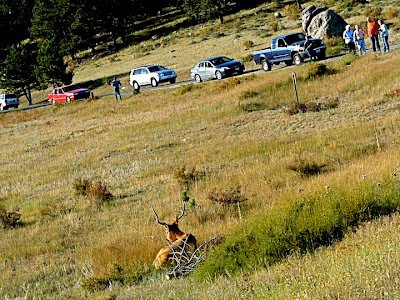
In mountain parks one always looks for the large mammals. By this time, at the end of September, the bear and sheep were cozy in their winter homes; but the elk were out attracting attention from the few remaining visitors.


On the road into Estes Park,
the tourist center for
Rocky Mountain National Park


Moraine Campground
was the last one open in the Park.


At the edge of the 8,000 ft. elevation valley,
we could see elk through the trees.


Joining the line-up,
we started shooting the seemingly unconcerned elk.


“Where are they?”


“There they are! Get out your longest zoom.”


The male guards his harem.


The bugle cry, warning to other males.


“There are too many of these smelly cars
on the trails these days!”


We had a foretaste of the fall color to come.


Thursday, December 20, 2007

148.9/23 Familiar Flowers of Summer - by Jean

Queen Anne’s Lace, Daucus carota,
roadside rest,
Ontario Province, Canada

One of the loveliest sights of summer is dainty Queen Anne’s Lace or wild carrot, Daucus carota in grassy places and along roadsides. A native of Europe, it grows in every State of the U.S.A. Long in cultivation, the carrots we eat are the root of the same plant, var. sativa.


Queen Anne’s Lace, Daucus carota,
Acadia National Park, Maine

The flower umbels mature into an interesting ball of bristly seeds.


Ox-eye Daisy, Chrysanthemum leucanthemum
(now Leucanthemum vulgare),
visited by hover-fly
Acadia National Park, Maine


The Ox-eye Daisy from Europe and Asia is found in all 48 states in open, moist places. Each white petal or ‘ray flower’ and each yellow ‘disc flower’ matures into a single seed. No wonder the daisy is so common!


Chicory, Cichorium intybus,
Ann Arbor, Michigan

A beautiful sky blue, chicory flowers are seen along roadsides and in vacant lots in the morning or on cloudy days. Once the sun is full, the flowers close for the day and the tough, weedy stems are scarcely noticeable. Another vagabond from Europe, it has spread throughout the United States. The root is roasted and ground and used as a coffee substitute, or to add a different, more bitter flavor to real coffee as savored in New Orleans and other francophile places.


Common Sunflower, Helianthus annuus,
at Scotts Bluff, Nebraska

The rank, weedy sunflower which brightens roadsides and fences in late summer is difficult to reconcile with the enormous cultivated sunflowers on stout stems that are grown for their seed and for floral bouquets, yet it is the same species. An American native, one of the earliest examples of its domestication is from the Hayes site in Tennessee dating back to around 2300 B.C. Another find from the Olmec site of San Andrés, Mexico dates to some time before 2100 B.C. (source: Wikepedia). Farmers grow the plants for the seed which is pressed for cooking oil or to produce biodiesel fuel, or added to bird seed mixes. The seeds are roasted into tasty snack morsels, and when hulled, added to salads and breads as a nutritious and flavorful supplement.


Tractor vs. Sunflower — Sunflower Wins!
Helianthus annuus,
Forest City, Iowa

In this member of the Asteraceae, formerly known as Compositae, only the central brown florets each form a single seed in a dry coat; the outer yellow ray flowers are sterile.


Goldenrod and White Aster,
Kaslow Prairie, Iowa

It’s mid-September and the Asteraceae family is at its most conspicuous.

Some 20 species of Goldenrod, Solidago sp., with tiny brilliant yellow flowers, bloom in prairies and edges of fields and creeks all over the United States. Formerly shunned because falsely believed to be allergenic, (Ragweed is the real culprit), they are finding a place in ornamental horticulture.

White Aster, Aster ericoides appears slender and dainty among tall green grasses, or as a low white mass in the dry, short-grass prairie of Nebraska. Growing from the east coast across two-thirds of the United States, I began to recognize it in bud in mid-August in Acadia National Park, Maine.


New England Aster, Aster novae-angliae,
Gering Arboretum, Nebraska

New England Aster is a stout 3 to 6 foot perennial with purple “daisy” flowers that is found in nearly all of the United States. Many shorter compact varieties have been developed for horticultural use with colors varying from pink to dark purple. Some were just opening in the U.S. Botanical Garden in Washington D.C. in early August.


Common Mullein, Verbascum thapsus,
Estes Park, Colorado

Not all late summer flowers are daisies. Wooly gray leaf rosettes on the ground (the first year) or 2 to 4 ft. tall stems (the second year) in barren places will call your attention to common mullein. This native of Europe and North Africa grows in all of our United States, and early assumed a role as an herbal remedy, the leaves being smoked by Indians. Teas prepared from the leaves, carefully filtered to eliminate the irritating hairs, seem to be helpful in pulmonary diseases.


Common Mullein, Verbascum thapsus,
Estes Park, Colorado

The yellow flowers peep out of wooly pale green sepals on the stout stems, and are pollinated by bees. The capsules of this member of the Snapdragon family turn brown, split and shed their tiny seeds and the whole plant becomes a dry, dead stick.


Butter and Eggs, Linaria vulgaris,
Acadia National Park, Maine

It’s a delight to spot a cluster of Butter and Eggs. I have photographed this lovely flower from Maine to California: in Ann Arbor, MI, the Tetons and Yellowstone, WY, Grand Coulee and Mount St. Helens, WA. It photographs best from below, so expect bruised elbows from the prostrate position in gravelly ground. The snapdragon-like flowers seem too pretty to be a weed that came to us from the Mediterranean region.

F.Y.I.
Search the name of any native plant in your favorite browser. An amazing amount of information is available. Look for “PLANTS Profile for (Latin name), (common name)” from //www.plants.usda.gov to see photos and a distribution map. Wikepedia references provide uses and history. [For fun, Google “Plants, Pawek” and “Pawekiae”]

Tuesday, October 2, 2007

145.9/20 A Lighthouse on the Oregon Trail

Through the windshield—
Chimney Rock from about 30 miles away

The Mormon Trail, Oregon Trail, and California Trail following the North Platte River from the Missouri River passed by one of the most famous landmarks along the Trail: Chimney Rock. Some half million westbound emigrants used it as a beacon during the three to four days it was in view, signaling to them that the second phase of their long journey west—the difficult mountain passage—was about to begin.

Hundreds wrote in their journals their impressions: Passed the chimney in the fore part of the day and the formation… has a tendency to fill the mind with awe and grandeur. Virgil K. Pringle, June 19, 1846.

Chimney Rock towers about 500 feet above the North Platte River. Because the spectacular tower marked a good camping spot with a dependable spring, many of the pioneers stopped nearby, described it with drawings, and carved their names in its base. Later it became the setting for the Pony Express, the telegraph, and a stage station.


Sunrise on the North Platte Valley


An old Mormon cemetery rests
at the base of Chimney Rock.


An old Mormon cemetery rests
at the base of Chimney Rock.


Mary lived for 74 years on two continents,
but did not live to see Zion (Utah).

The Mormon Trail, though side by side with the other Trails, was always separate, because the Mormons kept to themselves for fear of acts of violence against them.


At 6:48 a.m.,
the first rays of dawn light up Chimney Rock.


As the new day begins,
the Rock welcomes the hosts of emigrants
passing that day headed for
the beautiful, but rugged mountains of Wyoming.


Chimney Rock at Sunset


The 800 foot high Scotts Bluff is 35 miles west
of Chimney Rock along the Oregon Trail.


Originally, the Oregon, California, and Mormon Trails circumvented the rugged badlands surrounding Scotts Bluff until the Army improved the Trail through Mitchell Pass in 1850. The Pass is just south of the Scotts Bluff and it shortened the wagon train’s journey by a day.


Sunset over Scotts Bluff

Saturday, September 29, 2007

140.9/15 The Little Brown Church in the Vale

Iowa Corn Fields


As we angled across Iowa on our way to Winnebago Industries in Forest City, we passed through miles and miles of fields of tall corn.

Entering Chickasaw County, we made a brief detour through Nashua to The Little Brown Church with the Old Bradford Pioneer Village next door.


The Little Brown Church in the Vale


Dedicated 1864


The Little Brown Church has an interesting history. In June 1857, William Pitts, a young music teacher was traveling to nearby Fredericksburg to visit his bride-to-be. When the stagecoach took a noon rest at Bradford, Mr. Pitts was moved by the lovely setting among large oak trees. On his return home to southern Wisconsin, remembering his vision, he wrote The Little Brown Church in the Vale.


As It Must Have Looked


When Mr. Pitts returned to teach music at Bradford Academy, he was amazed to find a small church being erected across the road at the very spot he had visualized in his hymn. On dedication day in 1864 his vocal class gave the hymn its first public rendition. The church and the song became forever linked.

Mr. Pitts sold the song to a Chicago publisher for $25.00 and used the money to help earn a medical degree, then returned to Fredericksburg and set up practice.


Office of Dr. Wm. S. Pitts
Fredericksburg, Iowa


His office building is preserved in the Old Bradford Pioneer Village. The little community of Bradford, once a thriving village along the wagon trail west, had gradually disappeared when the railroad by-passed it for Fredericksburg.


Dr. Pitt’s Office

The Chickasaw County Historical Society has saved cottages, log cabins, a country school, general store and the first Fredericksburg railroad depot. Each of the 15 buildings is furnished appropriately. A barn is full of old agricultural equipment and one of the houses displays a collection of children’s toys.


Log Cabin Interior


Cast Iron Stove


Buffalo Skin Coat
Bill’s grandfather Henry Field,
seedsman wore one.


Early Washing Machine


Wall Phone and Telephone Switchboard
“Mrs. Brown this is an emergency call,
please get off the line!”


Iowa Tall Corn


We enjoyed remembering the old days, a pleasant break from tall corn fields.

The Little Brown Church ..in the Vale..